Why Africa’s Biggest Challenge May Not Be Unemployment
Everyone keeps talking about jobs.
Governments promise them. Institutions discuss them. Economists project them. Families worry about them. Young people chase them.
And understandably so.
But if you sit with the reality on the ground long enough — not the reports, not the statistics, not the conference presentations, but the everyday experiences of people navigating life across the continent — something starts to feel different.
The jobs, in many cases, already exist.
Some are being created.
Some are evolving.
Some are appearing in industries that did not even exist a few years ago.
The uncomfortable part is what happens next.
People are struggling to hold them.
That distinction changes the entire conversation because it shifts our attention away from employment alone and toward something larger: African future readiness.
Because you can create a million jobs and still have a workforce crisis.
Jobs do not exist in isolation. They exist inside systems — digital systems, communication systems, educational systems, institutional systems — and increasingly these systems require a different kind of fluency.
Not simply technical skills.
Something deeper.
The ability to think through complexity.
The ability to adapt when the environment changes.
The ability to understand context instead of memorizing instructions.
The ability to learn continuously instead of assuming learning has ended.
Those abilities matter because the world itself has changed.
There was a time when a qualification almost guaranteed predictability. Study for a particular profession, graduate, enter the workforce, remain there for decades.
That world left quietly.
Now industries change rapidly. Technologies evolve before institutions fully adapt to them. New opportunities appear while old assumptions disappear.
People are already experiencing this shift.
Young Africans are learning AI tools outside classrooms. They are teaching themselves digital skills on their phones. They are building businesses online, creating opportunities where traditional pathways sometimes fail to provide them.
That is remarkable.
But it also raises a difficult question.
If individuals are redesigning themselves for the future, who is redesigning the systems around them?
Because African digital literacy is no longer simply a conversation about technology.
It is becoming a conversation about participation.
Participation in economies.
Participation in knowledge systems.
Participation in building the future itself.
And this is where many institutions find themselves standing at a crossroads.
For decades, many educational systems rewarded memorization more than curiosity. Students often learned to repeat information before learning to question it. Success meant reproducing the correct answer rather than understanding how to arrive at one independently.
That model made sense for a world built around stability.
But stability is no longer guaranteed.
The future increasingly rewards people who can interpret, adapt, question, and build.
And perhaps that is why workforce development in Africa cannot simply become a conversation about producing more graduates or introducing more technical programs.
It must become a conversation about developing people capable of navigating change itself.
Because some of the most future-ready people on the continent never learned these skills inside formal institutions.
They learned through exposure.
Experimentation.
Necessity.
Curiosity.
Meanwhile some highly educated individuals continue struggling when reality moves outside the boundaries of what they were trained to expect.
Not because they lack intelligence.
Because no one taught them how to think beyond the structure they inherited.
This matters even more as AI in Africa becomes a larger conversation.
Artificial intelligence will not magically solve structural challenges.
Neither will it automatically destroy opportunities.
AI amplifies existing capability.
People who understand context, creativity, and judgment will become more effective.
People who depend entirely on instruction may become increasingly vulnerable.
And this is why the discussion becomes larger than economics.
It becomes a question of sovereignty.
Because institutions do more than produce workers.
They shape how societies think.
They shape confidence.
They shape identity.
They shape what future generations believe they deserve.
The young African sitting in a lecture hall today is not lacking intelligence.
They are not lacking ambition.
They are not lacking potential.
What they may be lacking is an institution brave enough to prepare them for a future that does not yet exist.
Because Africa’s biggest challenge may not be unemployment after all.
It may be whether we are preparing people to inherit the future — or simply preparing them to survive it.
And there is a difference.
The future rarely belongs to those who wait for it.
It belongs to those confident enough to design it.
MfalmeBits is an African-centered digital hub committed to building Africa’s narrative infrastructure through cultural literacy, institutional growth, and future-focused education.
Own Your Narrative.
African Affairs
Why Africa’s Biggest Challenge May Not Be Unemployment
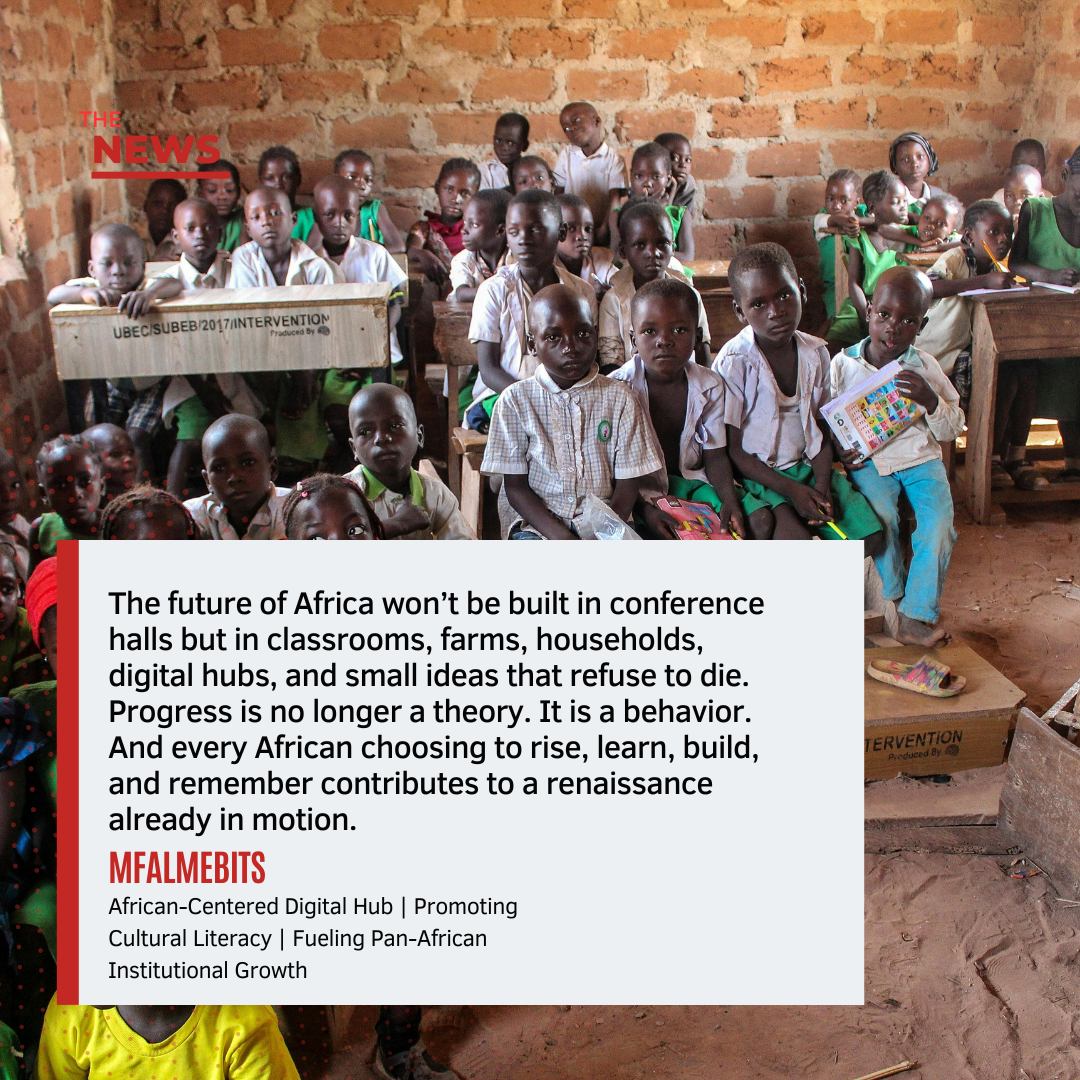
The conversation around Africa's workforce must go beyond job creation and ask whether people are being prepared for the future itself.
No comments yet. Be the first to share your thoughts!