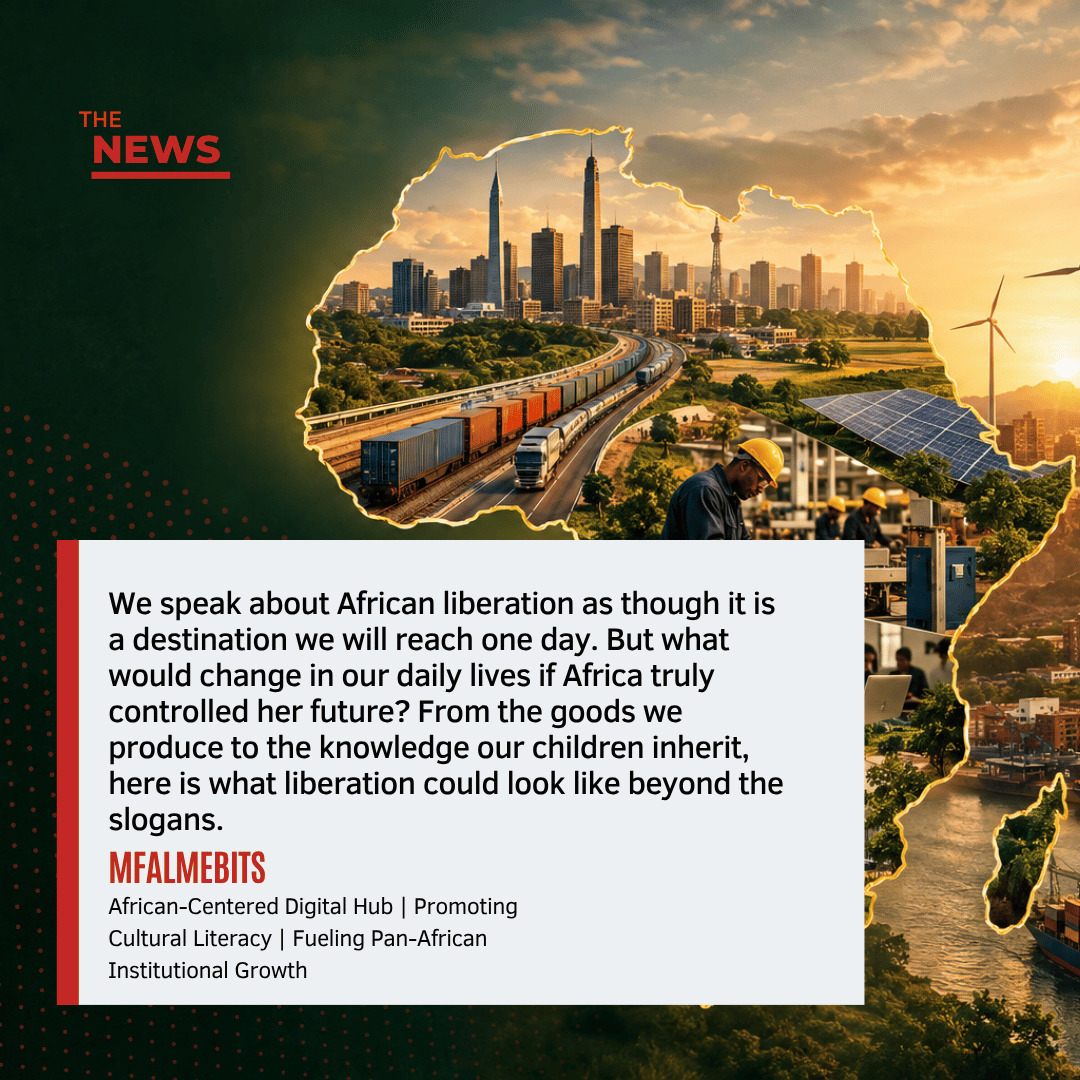
Imagine walking into a supermarket in Nairobi, Accra, Lagos or Ouagadougou. You pick up a bar of chocolate made from African cocoa, packaged by an African company, designed by an African creative, transported by an African logistics firm and sold through an African-owned distribution network. The profits support African workers, African families and African businesses. The product is not simply African because its ingredients came from African soil. It is African because the value created along the way also belongs to Africans.
Now imagine that same principle applying to the phones we use, the medicines we take, the clothes we wear, the software we depend on and even the lessons our children learn in school.
What would change?
Quite a lot, actually.
We have spent generations discussing African liberation through the language of independence, resistance, unity and freedom. These conversations matter. Our ancestors fought extraordinary battles to break the chains of colonial rule, and their sacrifices should never be reduced to a paragraph in a history textbook.
But there is a question we must be brave enough to ask ourselves: If political independence was the beginning, what does the finished work look like?
Because a country can have its own flag, national anthem, president and seat at the United Nations while still depending heavily on other parts of the world for the products it consumes, the technology it uses, the financing it needs and the knowledge through which it understands itself.
That is where the conversation becomes uncomfortable.
Liberation is not only about who governs a country. It is also about who owns its productive capacity, who shapes its education, who controls its knowledge, who benefits from its resources and who has the power to decide what happens next.
And before anyone mistakes this for a dream of Africa shutting herself away from the world, let us be clear: sovereignty does not mean refusing to trade, learn or cooperate with other nations. It means entering those relationships with choices, capabilities and bargaining power of our own.
So let us stop treating liberation as an abstract idea for a moment. Let us walk through what it could look like in the life of an ordinary African.
The first change would be visible in what we produce.
Africa is not short of things the world wants. The continent has agricultural resources, minerals, energy potential, creative talent and a growing generation of people capable of building businesses and solving problems. Yet possessing something and controlling the value created from it are two very different things.
Consider cocoa. A farmer can grow the beans, harvest them and sell them, while much of the processing, branding, manufacturing and retail profit happens elsewhere. The farmer participates in the beginning of the business, but may capture only a fraction of what the finished product eventually earns.
Think about that for a second. The raw material begins its journey in Africa, but the greater commercial opportunity may emerge thousands of kilometres away.
This is not an argument that every African country should manufacture everything it consumes. That would be neither practical nor necessary. It is an argument for building more of the capabilities that allow African people and businesses to move further up the value chain.
Instead of exporting only raw cocoa, how many more African enterprises could produce chocolate? Instead of selling unprocessed agricultural products, how many could build food-processing facilities, packaging companies, cold-storage systems and distribution networks? Instead of exporting minerals and importing expensive finished products, where can African countries develop the technical skills, energy systems and industries required to process more of those resources responsibly?
The African Union has recognised this challenge in its Agenda 2063 development framework, which includes an African Commodities Strategy intended to support value addition, diversification and stronger African participation in global value chains.
That is the important phrase: value addition.
In plain English, it means doing more with what we already have before handing it over to somebody else.
Imagine a farmer who once sold tomatoes at a low price because the harvest was too large for the local market. Now imagine that farmer working with a locally owned processing company that turns surplus tomatoes into packaged products, employs local workers and sells to supermarkets across several countries.
The tomato has not magically become more valuable because it is African. Its value has increased because people have built the knowledge, equipment, infrastructure and business relationships needed to do more with it.
That is the difference between possessing wealth and building an economy around it.
And if we want African liberation to become something people can feel, this is one of the places it must begin: in the businesses we build, the jobs we create, the industries we develop and the share of the value that remains within our communities.
The second change would be that Africa begins to feel less like 54 separate economic islands.
Imagine a Kenyan entrepreneur who makes excellent school furniture. The business grows, demand increases and the owner wants to sell to customers in Uganda, Rwanda, Tanzania, Ghana and beyond.
The opportunity seems obvious. There are schools across the continent. There are students who need desks. There are African manufacturers who can produce them.
But crossing a border can mean dealing with different regulations, customs procedures, transport costs, payment systems and other barriers. A business that can supply a town may struggle to supply a neighbouring country.
Now imagine those barriers becoming easier to navigate, regional transport networks improving, payments becoming more efficient and African businesses being able to reach customers across borders with fewer obstacles.
Suddenly, the entrepreneur is no longer competing for a small local market alone. The business can grow into a regional operation, employ more people, purchase materials from other African suppliers and build a stronger company.
This is part of the promise behind the African Continental Free Trade Area, or AfCFTA. The agreement seeks to expand trade among African countries and create a more integrated market for goods and services. The African Union also identifies regional integration and value addition as important parts of the continent's long-term development agenda.
But here is the part we should not overlook: signing a trade agreement does not automatically create a thriving African market.
A market must be built.
Businesses need roads. Goods need reliable transport. Manufacturers need electricity. Entrepreneurs need financing. Countries need workable customs systems. Traders need access to information about regulations and customers. And agreements must be implemented in ways that make a practical difference to the people they are meant to serve.
A border can disappear from a document while remaining very real in the cost of doing business.
African unity, therefore, cannot survive on beautiful speeches alone. It must become something a business owner can experience when moving goods, a student can experience when pursuing an opportunity and a family can experience when affordable products become more accessible.
When an African company can grow across African markets, it creates more than revenue. It helps build economic relationships that make cooperation worthwhile.
That is what unity begins to look like when it leaves the conference room.
The third change would be written into the roads beneath our feet.
Let us use Burkina Faso as a real example, not as proof that one country has solved all its challenges, but as a way of seeing how development becomes tangible.
On 14 March 2026, Burkina Faso's government announced the launch of work to rehabilitate the Bobo-Dioulasso–Banfora road and construct the Banfora–Orodara road. The announcement described an 84.7-kilometre rehabilitation project between Bobo-Dioulasso and Banfora, with a stated execution period of 24 months, alongside a 42-kilometre Banfora–Orodara project with an 18-month execution period. The stated costs were approximately 63 billion CFA francs and more than 18 billion CFA francs, respectively, before tax. These were announced projects, not evidence that the roads had already been completed. The details are reported by Burkina Faso's Government Information Service.
Why should we care about a road project in Burkina Faso?
Because a road is never just a road.
For a farmer, a better road can mean getting produce to market with fewer delays. For a trader, it can mean moving goods more reliably. For a student, it can mean a more manageable journey to school. For a business, it can affect transport costs, delivery times and the decision to expand into a new area.
Of course, those benefits depend on the road being completed, maintained and connected to functioning markets and services. Construction alone does not guarantee prosperity.
But this is the point: when we talk about African liberation, we must learn to recognise the practical systems that make freedom useful.
A farmer cannot take advantage of a growing market if the harvest cannot reach it. A manufacturer cannot compete consistently if electricity is unreliable. A brilliant student cannot turn knowledge into opportunity if education is inaccessible or the necessary tools are unavailable.
We sometimes discuss sovereignty as if it exists only in presidential offices and international negotiations. Yet it also exists in the distance between a farm and a market, the reliability of a power supply, the availability of clean water and the ability of a community to access the services it needs.
The big vision becomes real through these ordinary things.
And the ordinary things are precisely what millions of Africans experience every day.
The fourth change would begin in the classroom.
Imagine two students sitting for a lesson about Africa.
One learns about the continent mainly through colonial conquest, poverty, political instability and the familiar list of problems that supposedly explain why Africa is where it is.
The other learns those histories too, but also studies African systems of governance, ancient intellectual traditions, trade networks, inventions, philosophical ideas, artistic traditions and the people building businesses, technologies and institutions today.
The second student is not being taught to believe that Africa has never failed. They are being taught to understand the continent with greater depth.
There is a difference.
A serious education must be honest about injustice, corruption, conflict, exploitation and the decisions that have harmed African societies. But it must also give students the knowledge to understand African agency, examine what has worked, identify what has failed and imagine what can be built differently.
A child who learns only that Africa has problems may eventually mistake those problems for the continent's identity.
A child who learns the history behind those problems, the achievements that preceded them, the people who challenged them and the systems that could overcome them has a wider field of possibility.
This is not about replacing one narrow story with another. It is about giving people enough knowledge to think for themselves.
And the question extends beyond history lessons.
What if schools gave more students opportunities to study African industries, local entrepreneurs, regional trade, indigenous knowledge, agricultural innovation and the challenges facing their own communities? What if students were encouraged not merely to memorise information but to investigate local problems and design practical solutions? What if learning about African history helped them understand the responsibilities of citizenship, leadership and institution building?
The African Union's Agenda 2063 identifies education, science, technology, innovation and industrialisation as important parts of Africa's future. Its cultural initiatives also recognise the importance of preserving and communicating African history and heritage.
The vision is not simply to produce students who know more facts. It is to develop people capable of using knowledge to improve the societies in which they live.
That is a different kind of education.
And it matters because every factory needs skilled people. Every hospital needs trained professionals. Every technology company needs thinkers and builders. Every institution needs people who understand its purpose and can make it work.
A continent cannot build its future if its people are disconnected from the knowledge required to build it.
The fifth change would be that Africa stops treating innovation as something that must arrive from elsewhere.
Picture a young African developer who creates software to help small farmers track prices, manage stock and connect with buyers. Imagine a team building affordable tools for local languages, a manufacturer designing equipment suited to local conditions, or a group of researchers developing better ways to store food in places where electricity is unreliable.
These are not fantasies that require Africa to wait for permission. They are examples of the kinds of problems African innovators can work on now.
The important question is whether the surrounding environment gives those innovators a genuine chance.
Can they access funding? Can they find the equipment they need? Can they protect their intellectual property? Can they hire skilled workers? Can they reach customers across borders? Can public and private institutions help promising ideas move beyond the prototype stage?
An idea alone cannot transform an economy. It needs a path from imagination to practical use.
This is where the conversation about technology becomes much deeper than buying the latest devices or celebrating a new app.
Technological sovereignty does not mean that every piece of technology must be invented and manufactured within one country. It means developing the knowledge, skills, infrastructure and decision-making power to use technology intelligently, shape it to local needs and avoid becoming helpless when an external supplier changes its prices, access rules or priorities.
The same principle applies to artificial intelligence, digital services, research and creative industries.
If African people generate valuable knowledge, build useful software, create original designs and develop powerful ideas, they should be able to participate in the economic opportunities those creations generate. That requires education, investment, intellectual-property awareness, reliable infrastructure and institutions that support experimentation.
It also requires a change in how we see ourselves.
We must stop imagining African youth only as future employees waiting for someone to create opportunities for them. Employment matters, of course. But young Africans can also be researchers, inventors, manufacturers, publishers, business owners and institution builders.
The future will not be shaped only by the people who find a place inside existing systems. It will also be shaped by those who build new systems.
And that brings us to something we do not discuss nearly enough.
Who controls the knowledge through which Africa understands herself?
Think about the influence of a textbook. It can shape what a child believes is important, whose achievements deserve attention, which events are remembered and which possibilities seem realistic.
Now think about a documentary, a search engine, a digital archive, a film, a museum or an educational platform. Each one makes decisions about what to preserve, what to present, what to emphasise and what to leave out.
Knowledge is never just a pile of information. The way it is organised and communicated can influence what people value, what they believe is possible and what they decide to build.
This does not mean that every foreign publication is hostile to Africa or that every African source is automatically trustworthy. It means that a continent needs the capacity to document its own experiences, support serious research, preserve its languages and cultural knowledge, and make reliable information accessible to its people.
If African histories are poorly documented, difficult to access or disconnected from education, future generations may struggle to understand the experiences that shaped their societies.
If African intellectual property is not protected, its creators may lose control over how their work is used.
If local knowledge is dismissed before it is properly examined, useful ideas can disappear without ever being tested, preserved or developed.
And if young people grow up consuming information about Africa without having access to the tools needed to question it, they may inherit conclusions without understanding how those conclusions were formed.
This is why cultural literacy matters.
Cultural literacy is more than knowing the names of traditional dishes, wearing cultural clothing or celebrating a national holiday. It is the ability to understand the histories, ideas, practices and experiences that have shaped a people—and to engage with that knowledge critically, confidently and responsibly.
It allows us to distinguish heritage from myth, pride from exaggeration, and genuine cultural understanding from the superficial use of symbols.
It helps us ask better questions about who we are, how we arrived here and what we want to carry forward.
A society that understands its past is not trapped in it. It is better equipped to make conscious decisions about its future.
This is the deeper meaning behind Own Your Narrative.
It is not a demand that Africans tell only flattering stories about Africa. It is a demand that we develop the knowledge, confidence and institutions required to understand our experiences and participate in defining our future.
We must be able to celebrate what deserves celebration, confront what requires correction and preserve what future generations have a right to know.
That is how narrative ownership becomes a practical responsibility rather than a slogan.
So where does MfalmeBits fit into this future?
We should be honest about our place in the larger picture.
MfalmeBits cannot build Africa's roads, reform every school system, establish industries across the continent or solve the institutional challenges facing African nations. No single platform can do that.
But we can contribute to the knowledge infrastructure that makes progress easier to understand, teach and sustain.
Our work begins with a simple belief: African people should have access to educational resources that take their histories, cultures, intellectual traditions and future seriously.
Through African-centred publications, cultural learning materials, educational resources and institutional partnerships, MfalmeBits aims to help preserve knowledge, strengthen cultural literacy and make African perspectives more accessible to learners and educators.
Imagine a school looking for a resource that helps students understand African trade routes beyond a few lines in a textbook. Imagine a teacher searching for a learning kit that connects cultural heritage to entrepreneurship, citizenship or modern economic life. Imagine an institution that wants educational material grounded in African experiences and developed for meaningful learning.
The goal is to help make those resources available, useful and adaptable to the people who need them.
That is why our work must go beyond publishing something and hoping people read it.
Knowledge needs a home. Educational materials need structure. Schools and institutions need resources they can actually use. Creators need their work treated as intellectual property. Cultural knowledge needs to be preserved in forms that can reach people today and remain useful tomorrow.
Over time, MfalmeBits can develop its library of African-centred educational resources, work with educators and researchers, build relationships with schools and universities, and create licensing opportunities that help institutions access materials suited to their needs.
This is an ambition we must earn through quality, trust, collaboration and consistent work.
We are not claiming to have transformed African education. We are building towards a role in which our contribution can be measured by the usefulness of the knowledge we preserve, the resources we create and the institutions we are able to serve.
Because a movement becomes stronger when its ideas take form.
Own Your Narrative is the conviction. MfalmeBits is one of the ways we intend to put that conviction to work.
And if Africa is to become more sovereign, we need thousands of efforts like this, each working in its own field while contributing to a larger transformation.
We need farmers and food scientists improving agricultural systems. We need engineers building infrastructure. We need entrepreneurs creating industries. We need teachers preparing students for real challenges. We need researchers investigating difficult questions, artists preserving and reimagining cultural memory, and institutions that protect knowledge while making it accessible.
We need leaders who understand that power without accountability can weaken a nation, and citizens who understand that responsibility does not end when they cast a vote.
We also need the courage to examine ourselves honestly. External exploitation has shaped African history, but our future cannot depend on blaming outsiders for every failure. Corruption, poor decisions, weak institutions, exclusion and short-term thinking must be confronted wherever they occur.
Liberation requires the ability to recognise what has been done to us without surrendering responsibility for what we do next.
It requires cooperation without helpless dependence, cultural pride without historical dishonesty, and ambition supported by the discipline to build.
So, what would a liberated Africa actually look like?
It would look like a farmer whose work can reach a wider market. A business that can grow across borders. A factory turning local resources into products people can afford. A student learning about Africa with depth rather than shame or fantasy. A researcher whose work contributes to solving a problem. An institution that preserves knowledge and makes it useful. A community whose people have a greater say in the decisions affecting their lives.
It would look different from one country to another because Africa is not one uniform society. Our histories, resources, languages, needs and political realities differ. There is no single blueprint that can be copied everywhere.
But the direction is clear: more capability, more knowledge, stronger institutions, productive economies, greater cooperation and a deeper sense of responsibility for the future we share.
The question is no longer simply whether we can imagine such a continent.
The question is whether we are willing to build the systems that could make it possible—and whether we can measure our progress by what changes in the lives of ordinary people.
Our ancestors fought to open the door. Our responsibility is to build something worthy of walking through it.
And that work will not be completed by one speech, one government, one generation or one movement. It will be built through millions of decisions, institutions and acts of creation, repeated until a different reality becomes possible.
At MfalmeBits, that is the future we want to contribute to: an Africa whose people understand their histories, recognise their possibilities and possess more of the knowledge and tools required to shape what comes next.
Because Own Your Narrative is not simply about who gets to tell Africa’s story. It is about whether Africans possess the knowledge, institutions and collective will to build the future that story describes.
The story is ours to understand.
The responsibility is ours to carry.
And the future is ours to build.
No comments yet. Be the first to share your thoughts!