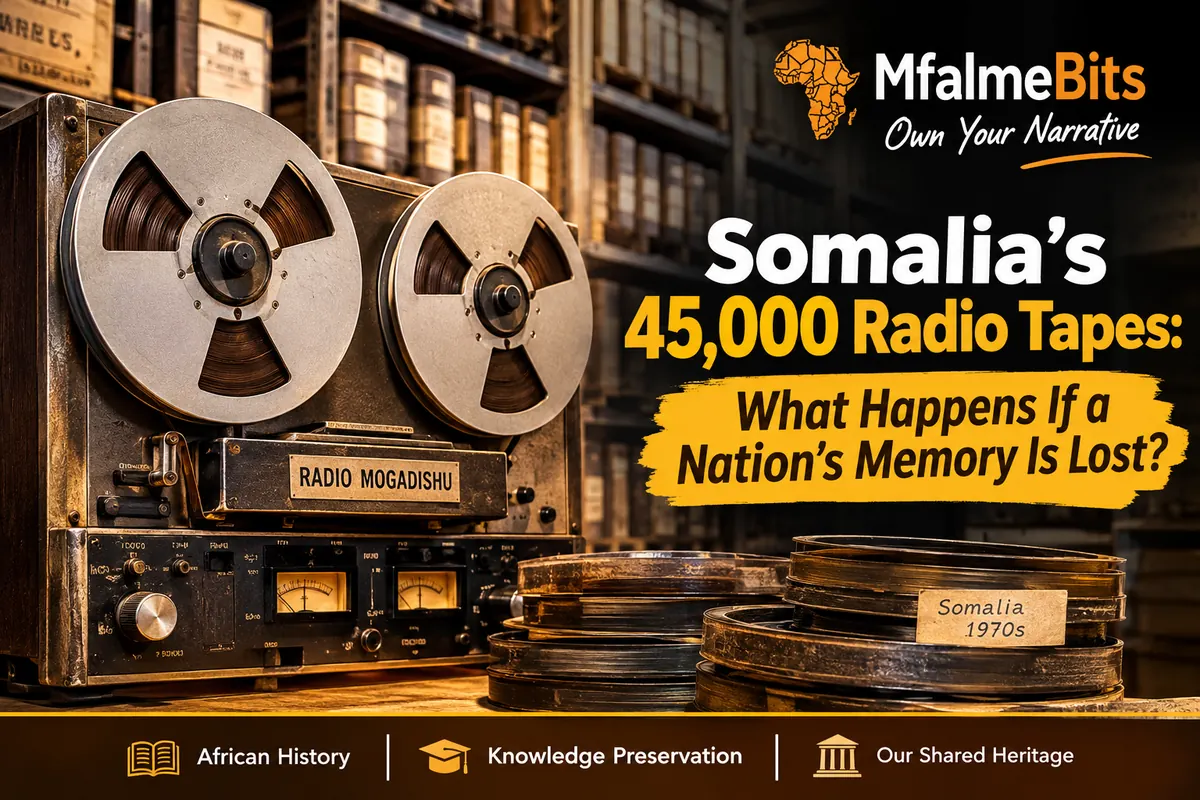
Somalia's 45,000 Radio Tapes: What Happens If a Nation's Memory Is Lost?
A nation's history does not only live in textbooks, monuments or museums. Sometimes, it lives on magnetic tape.
In Mogadishu, approximately 45,000 audio recordings preserve fragments of Somalia's modern history: political speeches, news broadcasts, music, poetry and everyday conversations. These recordings document generations of Somali life, yet many face the threat of deterioration.
UNESCO has been supporting efforts to preserve and digitise the Radio Mogadishu archive. But the situation raises a question that extends far beyond Somalia:
What happens when a nation risks losing the voices that documented its past?
More than an old radio collection
Established in 1951, Radio Mogadishu became an important part of Somalia's public and cultural life. Its broadcasts carried information, entertainment, political discussions and educational programmes to audiences across the country.
Among the recordings are materials connected to Somalia's 1972 literacy campaign, when radio played an important role in communicating educational messages and supporting the wider adoption of written Somali.
Think about that for a moment.
These tapes are not simply recordings of people speaking into microphones. They preserve evidence of how a society communicated, educated, entertained and understood itself.
A historical broadcast can help a researcher examine the language of a particular period. A musical recording can preserve artistic expressions that may otherwise disappear. A political speech can provide material for examining historical decisions and public communication.
The archive is therefore more than a broadcasting collection. It is part of Somalia's documentary heritage.
When the recordings begin to disappear
In June 2026, UNESCO reported on an assessment of the Radio Mogadishu archive.
The findings confirmed approximately 45,000 tapes. More than 85% remained in operable condition, approximately 10% had deteriorated significantly, and more than 5% had been destroyed or critically damaged through fire and other disasters.
There was another problem: the archive lacked a comprehensive cataloguing system, making individual recordings difficult to identify and retrieve.
Consider the implications.
A historical recording might physically survive, yet remain practically inaccessible because nobody can easily establish what it contains or where it is stored.
UNESCO and the Government of Japan have supported improvements to preservation facilities and the provision of digitisation equipment. However, the work of securing such a substantial collection is far from finished.
Preserving thousands of recordings requires more than machines. It requires trained personnel, reliable storage, documentation, funding and institutions capable of maintaining the work over generations.
What disappears when history is lost?
Historical preservation is often treated as the responsibility of archivists and historians. In reality, its consequences reach classrooms, research institutions and entire communities.
Imagine a Somali student researching the country's educational history. Without access to original broadcasts, that student may depend entirely on secondary accounts.
Imagine a musician studying earlier Somali musical traditions, or a researcher examining how political messages were communicated decades ago.
Original recordings offer evidence that written descriptions alone cannot always provide.
There is also a deeper human dimension.
Collective memory helps people connect their present circumstances with the experiences of previous generations. Stories, music, language and shared historical experiences contribute to how communities understand identity and belonging.
Of course, recordings are not automatically objective. They must be examined critically, placed in context and compared with other historical evidence.
But losing original material removes opportunities for future generations to investigate their own past.
Digitisation is only the beginning
Moving historical recordings into digital formats is essential, particularly when physical materials are deteriorating. But digitisation alone does not guarantee preservation.
Digital files still need reliable storage, backups, proper descriptions and systems that allow people to find and understand them.
There is also the question of ownership.
Who decides which recordings become publicly accessible? Who controls their distribution? How are communities represented, credited and consulted when their cultural material is reused?
Preservation should not become another way of separating communities from their heritage.
Responsible archives must consider consent, copyright, cultural protocols and appropriate access. The people whose histories are being preserved deserve a meaningful role in those decisions.
This is why African institutions need more than digitisation projects. They need long-term preservation policies, trained archivists, accessible knowledge systems and sustainable investment.
The responsibility of preserving what we inherit
Somalia's experience raises questions relevant to the rest of Africa.
Our historical knowledge exists in national archives, broadcasting stations, libraries, universities, museums and community collections. Some are well maintained. Others face limited resources, deteriorating facilities and inadequate documentation.
We cannot continue treating cultural preservation as something reserved for heritage celebrations and occasional public speeches.
It requires working institutions.
Universities must support historical research. Public broadcasters must protect their records. Libraries and museums must improve access. Technology institutions must help build reliable digital infrastructure.
And educational platforms must help turn preserved knowledge into material that people can actually learn from.
This is part of the thinking behind MfalmeBits and our Knowledge Archive: making African knowledge more accessible, supporting cultural literacy and contributing to the wider systems through which future generations encounter their heritage.
The 45,000 Radio Mogadishu tapes represent more than an impressive number. They represent voices, experiences and historical evidence that deserve to survive.
Some have already been lost. Others remain vulnerable. What matters now is whether the institutions responsible can preserve what remains and make it meaningful to future generations.
There is a question every generation must eventually answer:
What did we do with the knowledge that was entrusted to us?
Owning your narrative is not only about telling your story. It is about protecting the evidence of your history, preserving the voices that came before you and ensuring that those who follow have something substantial to build upon.
MfalmeBits — Own Your Narrative.
No comments yet. Be the first to share your thoughts!